
Gauze detection
Computer Vision–Based Detection and Tracking of Surgical Gauze in Operative Videos
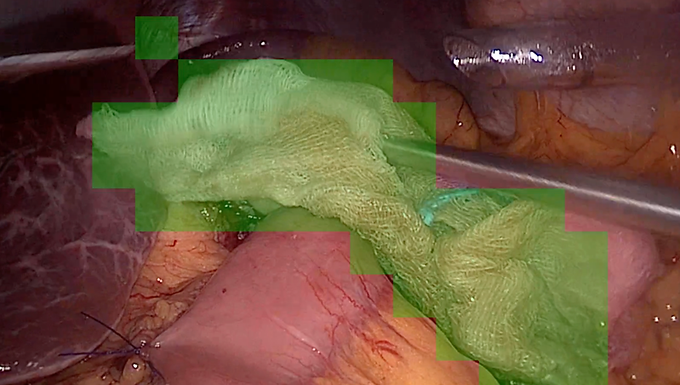
Surgical gauze is routinely used during operative procedures for blood absorption, tissue manipulation, and maintaining a clear surgical field. Failure to detect or account for gauze intra-operatively can lead to serious complications, including retained surgical items and postoperative infections.
The aim of this project is to develop a computer vision system that analyzes laparoscopic or open surgical video to detect, localize, and track surgical gauze in real time or offline analysis. Using real surgical video data, students will design, implement, and evaluate vision-based methods that identify gauze presence and movement within the operative field, supporting surgical safety and workflow awareness.
Mentor Details:
Prof. Yoav Mintz
Mentor Details:
Requirments:
Students will aim to:
Analyze surgical video data to characterize visual features of gauze
Develop a computer vision pipeline for gauze detection and tracking
Apply deep learning–based models (e.g., CNNs, Vision Transformers) to image or video data
Incorporate temporal consistency to improve detection stability
Evaluate performance using appropriate computer vision metrics
Problem Statement
Surgical video-based gauze detection presents several challenges:
Gauze appearance varies widely (dry vs blood-soaked, folded, crumpled)
Color and texture can change rapidly due to bleeding
Partial occlusion by instruments and tissue
Deformation and motion during manipulation
Visual similarity to surrounding tissue or fat when saturated
These factors make reliable gauze detection difficult, especially under real-world surgical conditions. The problem is to design a vision-based system that can robustly detect and track surgical gauze across frames or video sequences with high reliability.
Project Objectives
Students will aim to:
Analyze surgical video data to characterize visual features of gauze
Develop a computer vision pipeline for gauze detection and tracking
Apply deep learning–based models (e.g., CNNs, Vision Transformers) to image or video data
Incorporate temporal consistency to improve detection stability
Evaluate performance using appropriate computer vision metrics
Technical Scope
The project may include one or more of the following components:
Object detection of surgical gauze in laparoscopic or open surgery videos
Semantic or instance segmentation of gauze regions
Temporal tracking of gauze across video frames
State classification (clean vs blood-soaked gauze)
Weakly supervised learning using procedure logs or manual frame-level labels
Required Knowledge and Prerequisites
Core Requirements
Familiarity with fundamental computer vision concepts
Experience with convolutional neural networks (CNNs)
Basic knowledge of deep learning frameworks (e.g., PyTorch, TensorFlow)
Ability to work with image and video datasets
Recommended Background
Object detection and segmentation architectures (e.g., YOLO, Mask R-CNN)
Video tracking and temporal modeling
Model evaluation metrics (precision, recall, F1-score, IoU)
No prior surgical knowledge is required; relevant clinical context will be provided.
Project Difficulty and Expected Level
Vision complexity: Moderate to high (appearance variability, occlusion)
Modeling complexity: Moderate
Domain knowledge: Low
This project is well-suited for:
Teams of 2–4 students
Expected Outcomes
A working computer vision prototype for gauze detection and tracking
Quantitative evaluation on surgical video datasets
Analysis of false positives and failure cases
Well-documented code and a technical report